
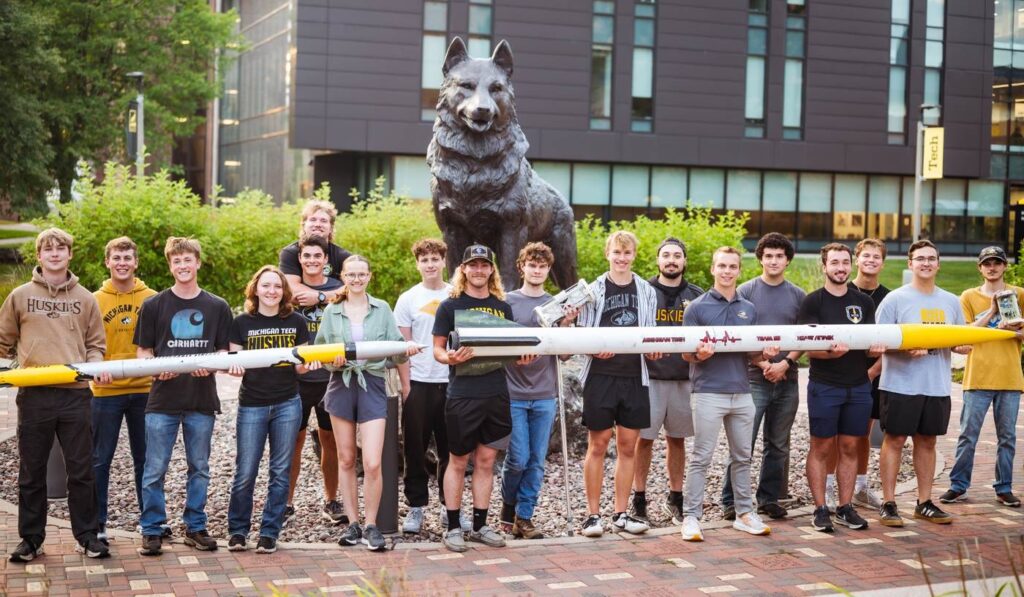
History
The High Powered Rocketry team began in January 2024, initially working alongside the Keweenaw Rocket Range to compete at the 2025 International Rocket Engineering Competition (IREC). During its first season, the team focused on developing the scientific payload while Keweenaw Rocket Range developed the launch vehicle. The team finished within the top third of roughly 150 teams from around the world.
In August 2025, the team expanded its scope to develop the entire competition vehicle in-house, including the launch vehicle, payload, and avionics. At the 2026 IREC, the team successfully launched the 10-foot-tall Heart Attack, carrying the Metal Heart cardiovascular research payload and a fully student-developed avionics system. The vehicle achieved full recovery points, while the team placed 10th out of 170 teams for build quality. The team is now developing its vehicle for the 2027 IREC.

Our Goal
The primary goal of the High Powered Rocketry team is to design, manufacture, test, and compete with a student-built launch vehicle at the International Rocket Engineering Competition. The team is working toward a vehicle capable of reaching 10,000 feet above ground level while carrying student-researched-and-developed avionics, flight dynamics systems, and a scientific payload.
Through the competition, members gain hands-on experience across the complete development of a high-powered rocket while continuing to expand the team’s in-house engineering capabilities.
Past Missions
IREC 2025 – Questionable Lineage


While spring semester of 2025 was the first semester of AERE and our High Powered Rocketry team we teamed up with the rocketry club (Keweenaw Rocket Range); HPR focused on the payload while Keweenaw Rocket Range made the launch vehicle. The goal was to get to as close to 10,000 feet as possible in altitude while having a 2kg or heavier payload. For our payload the goal was to develop a compressed gas roll control system. However with limited time HPR was unable to fully test it before hand and just had it collect data during the competition launch. In the end HPR placed 48th out of the 146 teams that launched, placing in the top third as a first time competition team.